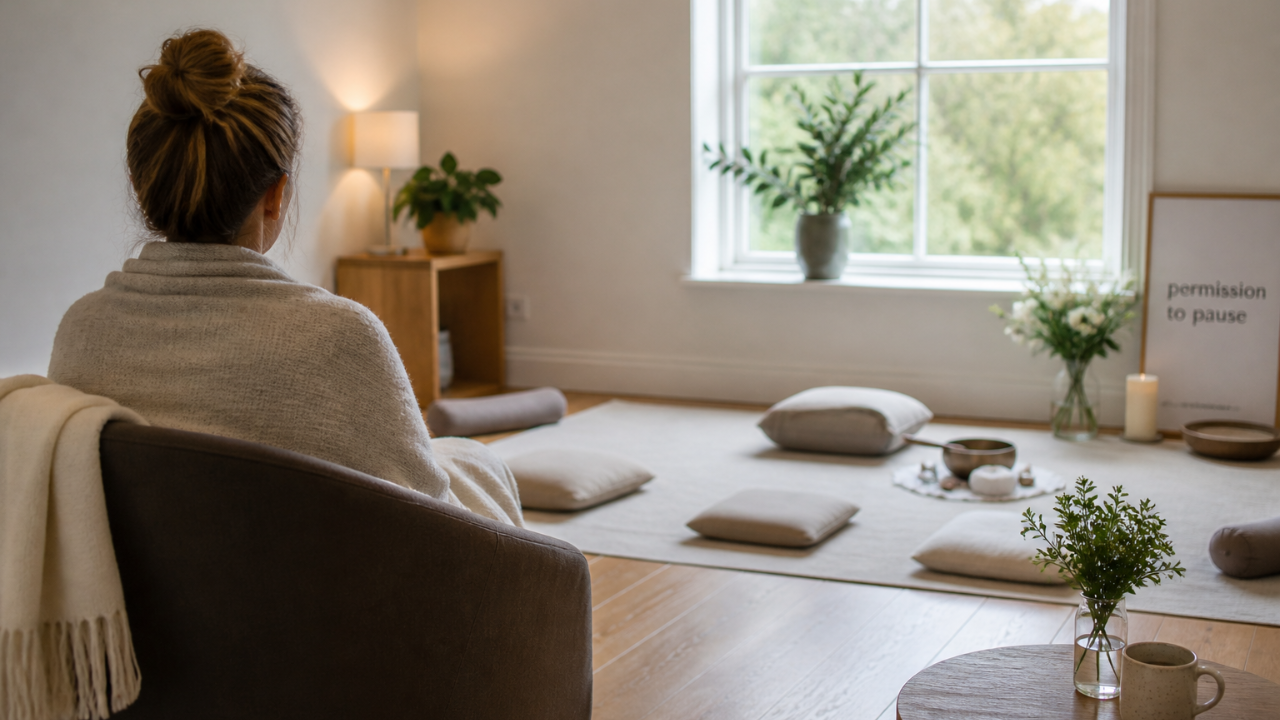
Creating capacity, before overwhelm becomes a wellbeing or performance problem.
Modern working life places increasing demands on people’s attention, energy and capacity.
People often move from task to task, meeting to meeting and responsibility to responsibility without enough opportunity to pause, reset or notice how much capacity they actually have available.
Permission to Pause gives employees practical ways to restore space, clarity and capacity in the moment, while developing the awareness to recognise and respond to reduced capacity earlier.
Through short guided pauses and longer settling sessions, employees can step out of the constant feeling of being “on”, settle their nervous system and reconnect with themselves before continuing with their day.
The immediate benefit is simple: people have an opportunity to pause, settle and feel better in the moment.
Over time, something else begins to develop. People become more able to notice when pressure is building or their capacity is reducing — and to respond earlier rather than simply continuing to push through.
It supports people now — and helps prevent pressure from becoming a bigger problem later.
Safety affects capacity. Capacity affects function.
The work is simple, practical and designed to fit into real working life.
⸻
What’s Included
Permission to Pause can be offered as a 6-week workplace programme and may include:
* Access to short guided pauses (3–5 minutes)
* Longer settling sessions
* Flexible online access for employees
* A live introductory session
* Support during the six weeks
* A closing session and opportunity for reflection
The pauses can be used practically throughout the working day — before meetings, between tasks, during breaks, after a difficult interaction, before leaving work or at home.
They don’t require employees to learn complicated techniques or add another demanding wellbeing practice to their day.
They simply create regular opportunities to pause, settle, notice and restore capacity.
⸻
Why Capacity Matters
Our capacity is not fixed.
It can be affected by workload, sustained concentration, uncertainty, responsibility, change, relationships, health, poor sleep and the ordinary demands of life outside work.
Yet people can often continue functioning after their capacity has begun to reduce.
They may become less clear, less patient, more reactive, more fatigued or find it increasingly difficult to think, communicate and make decisions — while continuing to push through because the working day hasn’t stopped.
Permission to Pause helps people become more aware of these changes.
The aim is to develop a simple everyday pathway:
Recognise → Pause → Reassess → Communicate → Respond appropriately → Restore capacity
Sometimes the appropriate response is simply taking a few minutes to settle before continuing.
At other times it may mean asking for support, communicating reduced capacity, reconsidering a demand or recognising that something needs to change.
The purpose isn’t to help people tolerate unsustainable pressure.
It’s to help them recognise and respond to themselves earlier.
⸻
Who It Supports
Permission to Pause is designed for everyday working life — not only for people who are already struggling.
Everyone experiences fluctuations in capacity, and everyone can benefit from having practical ways to pause and reset during periods of demand.
It can be particularly valuable for employees experiencing:
* Sustained pressure or responsibility
* Mental fatigue
* Difficulty switching off
* Reduced clarity or concentration
* Increasing stress or overwhelm
* Periods of significant workload or change
It can also support organisations looking for a practical, preventative and human-centred way of supporting employee wellbeing and sustainable capacity.
⸻
Working Alongside Existing Wellbeing Support
Permission to Pause is not psychological therapy or a mental-health treatment programme.
It is designed to work alongside, rather than replace, an organisation’s existing mental-health and wellbeing provision.
While existing services may provide important support for employees experiencing mental-health or wellbeing difficulties, Permission to Pause develops an everyday skill that can be used much earlier.
Employees learn to notice their own capacity, regulate and create space in the moment, and recognise when they may need to respond differently or access further support.
In this sense, Permission to Pause works upstream.
It provides support in the present while helping to prevent everyday pressure from developing into a more significant wellbeing or performance problem.
Prevention and support don’t have to be separate. The same pause that helps someone feel better now can also help them recognise themselves earlier next time.
⸻
A Different Approach to Workplace Wellbeing
Permission to Pause does not ask people to become better versions of themselves or give them another set of wellbeing tasks to complete.
It starts with something much simpler:
What is happening within me right now, and what do I need?
When people have opportunities to pause, they can begin to recognise pressure, fatigue, overload and reduced capacity sooner.
That creates more possibility for choice.
The intention is not to increase performance through pressure or to make employees responsible for coping with unreasonable demands.
The intention is to support people in maintaining and restoring the capacity from which they work, communicate, think and make decisions.
Manage processes. Support people.
⸻
Workplace Pilot Programme
Permission to Pause can be introduced through a 6-week workplace pilot.
This gives an organisation an opportunity to experience the work on a manageable scale and explore how it supports employees in everyday working life.
The programme combines an introduction to the principles behind Permission to Pause with practical resources employees can use throughout the six weeks.
Rather than simply giving people information about wellbeing, the intention is to help them develop a skill they can actually use:
recognising when their capacity is changing and knowing how to respond.
Engagement and overall staff experience can be reviewed anonymously through simple feedback and usage patterns without collecting personal or sensitive information.
If you would like to explore a pilot programme, please get in touch.
⸻
Continue the Support
Following the initial 6-week programme, organisations can choose to continue with Permission to Pause Plus.
Permission to Pause Plus builds on the awareness and skills developed during the initial programme, providing ongoing opportunities for employees to pause, settle and restore capacity alongside further support around capacity awareness, nervous-system regulation, recovery and sustainable ways of working.
The intention is not to create another wellbeing initiative employees have to keep up with.
It is to make recognising, pausing and responding a more natural part of everyday working life.
⸻
Explore Workplace Support
Your organisation may already have valuable mental-health and wellbeing provision in place.
Permission to Pause doesn’t need to replace it.
A useful starting question is:
What support do your people currently have to recognise and respond when their capacity begins to reduce — before it becomes a bigger wellbeing or performance problem?
If you would like to explore whether Permission to Pause could add something useful to your existing provision, please get in touch to arrange an initial conversation.
Email Sarah About Workplace Support
